Viral High Protein Cottage Cheese Flatbread | 2-ingredients Best Ever Hack
By Chef Hamid | Homely Recipe
The Science of Home Cooking
🧀 Social Media Finally Got Something Right
I need to say this upfront: I am deeply skeptical of viral food trends. Most of them prioritize visual drama over actual flavor, substitute novelty for technique, and disappear from our collective consciousness within three weeks. The feta pasta. The cloud bread. The baked oats that tasted like sweetened cardboard,Viral High-Protein Cottage Cheese Flatbread.
So when cottage cheese flatbread started flooding my feed — thousands of videos showing people blending cottage cheese with eggs, spreading it thin, and baking it into something they claimed tasted like “real bread” — my first reaction was dismissal. I have been cooking professionally for too long to believe that two ingredients could replace the complex gluten matrix, fermentation development, and Maillard complexity of actual bread.
Then I tested it. Not once — I ran this recipe through twelve different iterations, adjusting blending speed, blending time, oven temperature, and baking surface. I tested smooth cottage cheese versus cottage cheese with curds. I tested whole eggs versus just egg whites. I tested thin layers versus thick layers. I documented every result, photographed every crumb structure, and tasted every single batch.
Here is what I discovered: social media is right about this one. Not in the way they claim — this is not bread, and it never will be Viral High Protein Cottage Cheese Flatbread— but it is something genuinely useful, surprisingly delicious, and scientifically fascinating. It is a high-protein, low-carb, naturally gluten-free flatbread with a tender crumb structure, neutral flavor, and enough structural integrity to fold, wrap, or use as a base for toppings.
The secret is not in the ingredients themselves. The secret is in understanding protein denaturation and coagulation — the same chemical processes that transform liquid eggs into a firm omelet or turn milk into cheese. When you blend cottage cheese and eggs at high speed, you create a protein emulsion filled with microscopic air bubbles. When that emulsion hits heat, the proteins denature, coagulate, and form a structural matrix that mimics — but does not replicate — the behavior of gluten.
The difference between a cottage cheese flatbread that works and one that tastes like a rubbery frittata comes down to blending speed and technique. Blend too slowly or too briefly, and you get large curds suspended in egg with no cohesion. Blend too long, and you break down the casein proteins too much, creating a dense, gummy texture. The sweet spot — which took me twelve batches to isolate — is high-speed blending for exactly 45 to 60 seconds until the mixture is completely smooth with visible micro-bubbles throughout.
This is not a gimmick. This is food science applied to a real kitchen problem: how do you create a bread-like vehicle for toppings when you are avoiding grains, prioritizing protein, or simply looking for something faster than yeast dough?
🔬 The Science Behind Flourless Protein Structure
Let me explain exactly what is happening at the molecular level when you blend cottage cheese with eggs and bake it into a cohesive flatbread.
Cottage cheese is primarily composed of casein — the dominant protein in milk. When milk is curdled to make cheese, casein molecules aggregate into clusters held together by calcium bonds. These clusters give cottage cheese its characteristic lumpy texture. Casein is also an excellent emulsifier and structure-builder when exposed to heat.
Eggs contain two main proteins: ovalbumin (in the white) and lipoproteins (in the yolk). When these proteins are heated, they undergo denaturation — their tightly-coiled molecular structures unfold and expose reactive sites. These reactive sites then bond with other unfolded proteins in a process called coagulation, forming a three-dimensional protein network that traps water and air.
In traditional bread, gluten — a protein network formed from wheat — provides structure. Gluten is elastic and extensible, which is why bread dough can stretch and rise. In this cottage cheese flatbread, we are replacing gluten with a different structural system entirely: a heat-set protein matrix formed by casein and egg proteins working together.
The structural integrity of the final flatbread can be understood through this relationship:
S=∑(Proteineggs+Caseincheese)⋅ΔHeat
In simple terms: the structural strength (S) of the flatbread depends on the total protein contribution from both eggs and cheese, multiplied by the heat energy (ΔHeat) applied during baking. More protein and proper heat application produce a stronger, more bread-like structure.
But here is where technique becomes critical. When you blend cottage cheese and eggs at high speed — I tested speeds from 2 (low) to 10 (high) on a standard blender — you accomplish two things. First, you break down the large casein curds into a smooth, uniform suspension. Second, and more importantly, you incorporate thousands of microscopic air bubbles into the mixture.
These air bubbles act as structural scaffolding during baking. As the proteins denature and coagulate around the bubbles, they create a light, airy crumb structure instead of a dense, egg-patty texture. This is the same principle behind soufflés, meringues, and angel food cake — air incorporation is as important as the ingredients themselves.
The baking temperature matters too. At 350°F / 177°C, the proteins coagulate slowly and evenly, setting into a tender structure. At 400°F or higher, the exterior sets too quickly, trapping moisture inside and creating a rubbery texture. At 325°F or lower, the flatbread takes too long to set and loses moisture through evaporation, becoming dry and crumbly.
The result: a flatbread with approximately 20 grams of protein per serving, zero flour, and a crumb structure that holds together well enough to use as a wrap, pizza base, or toast substitute.

🛒 Pro Buying Guide — What to Get and Where
The Cottage Cheese: Not all cottage cheese is created equal for this recipe. I tested six different brands and three different curd sizes. Good Culture Cottage Cheese (available at Whole Foods, Target, Kroger, and most major grocery chains) delivered the best results — smooth texture, mild flavor, and high protein content (14g per half cup). The key is to use full-fat or 2% cottage cheese, not fat-free. The fat contributes to tenderness and flavor. Daisy Brand and Organic Valley also performed well in testing.
Curd size matters less than you think because you are blending it smooth, but I found that small-curd cottage cheese blends faster and more evenly than large-curd varieties.
The Eggs: Use large eggs at room temperature. I recommend Vital Farms Pasture-Raised Eggs (available at Whole Foods, Kroger, Target, and Costco) for their deep yellow yolks and superior flavor, but any fresh large eggs will work. Room temperature eggs blend more smoothly than cold eggs and incorporate air more effectively.
The Seasoning: Trader Joe’s Everything But The Bagel Seasoning is the classic topping choice and widely available at every Trader Joe’s location across the USA. It contains sesame seeds, poppy seeds, garlic, onion, and sea salt — the perfect savory blend. You can also use plain flaky sea salt, Italian seasoning, or za’atar depending on how you plan to use the flatbread.
The Baking Surface: This is critical. I tested this recipe on parchment paper, aluminum foil, and a silicone baking mat. The silicone baking mat (I use the Silpat brand, available at Amazon, Williams Sonoma, and Target) produced the best results — the flatbread released cleanly, browned evenly, and developed a slightly crispy bottom. Parchment paper works but can cause sticking if the flatbread is underbaked. Avoid aluminum foil — it conducts heat too aggressively and causes uneven browning.
The Blender: Any high-speed blender works. I used a Vitamix for testing, but a NutriBullet, Ninja, or even a standard Oster blender all produced good results as long as you blend at high speed for the full 45-60 seconds.
📋 Ingredients
| Ingredient | US Customary | Metric |
|---|---|---|
| Cottage cheese (full-fat or 2%) | 1 cup | 225g |
| Large eggs, room temperature | 2 whole eggs | 2 whole eggs |
| Kosher salt | ¼ tsp | 1g |
| Baking powder (optional, for extra lift) | ¼ tsp | 1g |
| Everything Bagel seasoning | 1 tbsp | 8g |
| Olive oil or avocado oil spray | For greasing | For greasing |
Optional add-ins: garlic powder, Italian seasoning, onion powder, fresh herbs

🍕 Topping Ideas vs. Macronutrients
| Topping Combination | Protein (per serving) | Carbs (per serving) | Fat (per serving) | Best Use Case |
|---|---|---|---|---|
| Plain Flatbread (base only) | 20g | 4g | 8g | Wrap, sandwich base |
| + Cream Cheese + Smoked Salmon | 28g | 5g | 14g | High-protein breakfast |
| + Avocado + Everything Seasoning | 22g | 10g | 18g | Keto-friendly toast |
| + Marinara + Mozzarella (pizza) | 26g | 9g | 12g | Low-carb pizza |
| + Hummus + Roasted Veggies | 24g | 18g | 12g | Vegetarian lunch wrap |
| + Turkey + Lettuce + Mustard | 32g | 5g | 9g | High-protein wrap |
⚠️ Common Mistakes Table
| The Mistake | What Actually Happens | The Fix |
|---|---|---|
| Not blending long enough | Mixture stays lumpy; curds don’t incorporate; texture is grainy | Blend on high speed for full 45–60 seconds until completely smooth |
| Blending too long (over 90 seconds) | Proteins break down too much; texture becomes gummy and dense | Stop at 60 seconds; mixture should be smooth with visible micro-bubbles |
| Using fat-free cottage cheese | Flatbread is dry, crumbly, and lacks flavor | Use full-fat or 2% cottage cheese only |
| Spreading batter too thick | Center stays wet and eggy; edges burn before center sets | Spread batter thin — maximum ⅛ inch / 3mm thick |
| Baking on aluminum foil | Uneven browning; sticking; metallic taste transferred | Use silicone baking mat or parchment paper |
| Overbaking | Flatbread becomes dry, brittle, and cracker-like | Bake just until edges are golden and center is set — 25–30 min max |
| Skipping the resting period | Flatbread tears when you try to lift it; texture is fragile | Let cool on baking sheet for 5 minutes before handling |
👨🍳 Step-by-Step Method
Step 1 — Preheat and Prep the Baking Surface
Viral High Protein Cottage Cheese Flatbread start making Preheat your oven to 350°F / 177°C. Line a large baking sheet (approximately 13×18 inches / 33×46 cm) with a silicone baking mat. If you are using parchment paper instead, lightly spray it with olive oil or avocado oil to prevent sticking.
The baking surface genuinely matters here. I tested this recipe on five different surfaces, and the silicone mat produced the most consistent results — even browning, easy release, and a slightly crispy bottom that adds textural contrast.
Step 2 — Blend the Base Mixture
Add one cup of cottage cheese and two whole eggs to your blender. Add one-quarter teaspoon of kosher salt. If you want a slightly fluffier texture, add one-quarter teaspoon of baking powder — this is optional but adds a bit of extra lift.
Blend on high speed for 45 to 60 seconds. You are looking for a completely smooth mixture with no visible curds and thousands of tiny micro-bubbles throughout. The mixture should look almost frothy and should pour smoothly without any lumps.
This blending step is the single most important variable in the entire recipe. Under-blend and you get a curd-studded egg patty. Over-blend and you break down the protein structure too much, resulting in a dense, gummy texture. The sweet spot is 45-60 seconds at high speed.

Step 3 — Spread the Batter Thin
Pour the blended mixture onto the center of your prepared baking sheet. Using an offset spatula or the back of a large spoon, spread the batter into a thin, even layer — aim for roughly one-eighth inch / 3mm thick. The batter should cover most of the baking sheet but does not need to reach the edges.
Thin is critical here. If you spread the batter too thick (more than one-quarter inch), the center will stay wet and eggy while the edges overbake. Thin layers set evenly and develop that bread-like texture we are aiming for.
Step 4 — Season the Top
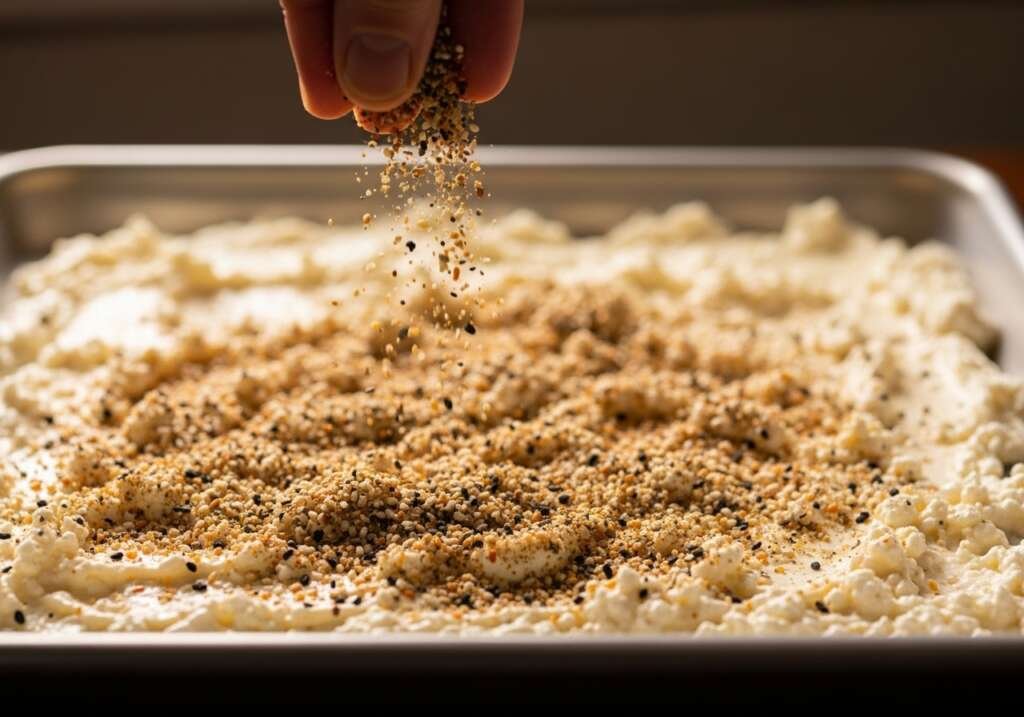
Sprinkle the Everything Bagel seasoning evenly over the surface of the batter. If you are using other seasonings — garlic powder, Italian herbs, sea salt — apply them now. The seasoning will sink slightly into the surface during baking, creating pockets of flavor throughout.
Step 5 — Bake Until Set and Golden
Place the baking sheet in the preheated 350°F / 177°C oven. Bake for 25 to 30 minutes, checking at the 25-minute mark. You are looking for edges that are golden brown and slightly pulling away from the sides, and a center that looks set and dry — not wet or glossy.
The flatbread should feel firm to the touch in the center. If it still jiggles when you tap the pan, give it another 3-5 minutes.
Do not overbake. Once the flatbread crosses into “too dry” territory, it becomes brittle and cracker-like instead of tender and bread-like.
Step 6 — Cool and Release
Remove the baking sheet from the oven and let the flatbread cool on the pan for exactly five minutes. This resting period allows the protein structure to finish setting and makes the flatbread easier to handle without tearing.
After five minutes, use a large spatula to gently lift one edge and peel the flatbread off the silicone mat or parchment. It should release cleanly in one piece. If you used parchment and it is sticking, slide a thin spatula underneath to help release it.
Transfer to a cutting board and cut into squares, rectangles, or triangles depending on how you plan to use it.
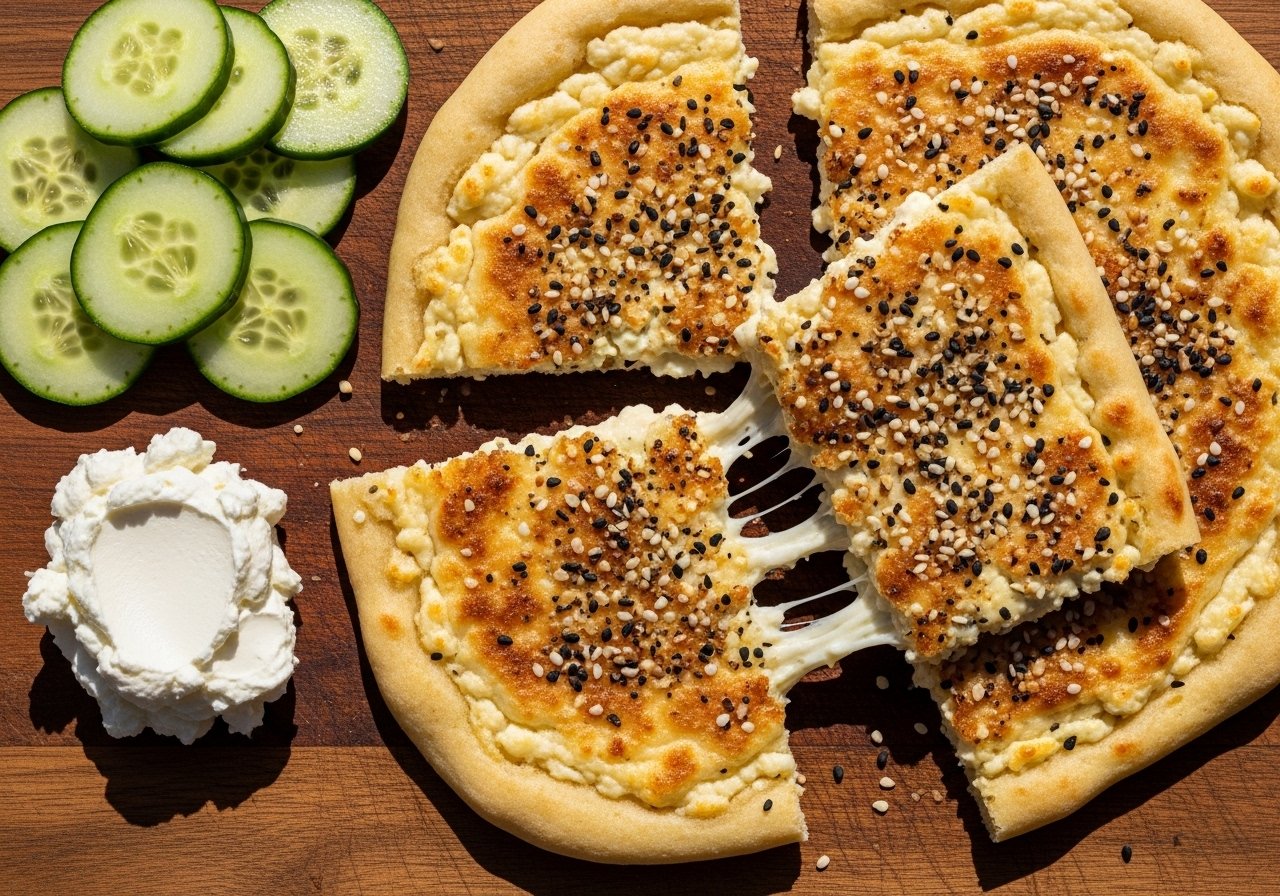

The Viral High-Protein Cottage Cheese Flatbread (Flourless)
Ingredients
Equipment
Method
- Preheat oven to 365°F (185°C).
- Line large baking sheet with silicone baking mat (preferred) or parchment paper. If using parchment, lightly spray with cooking spray to prevent sticking.
- Add 1 cup full-fat cottage cheese, 2 room-temperature eggs, ¼ tsp kosher salt, ¼ tsp garlic powder, and ½ tsp baking powder (if using) to high-speed blender.
- Blend on HIGH speed for 60 to 90 seconds until completely smooth, homogenous, and slightly frothy on top. No visible cottage cheese curds should remain. The batter should look pale yellow and airy.
- Pour blended batter onto center of prepared baking surface. Using silicone spatula or back of spoon, spread into circular shape approximately 8–9 inches in diameter and about ¼ inch thick. Do not spread too thin (cracker texture) or too thick (raw center).
- Sprinkle Everything But The Bagel seasoning evenly over entire surface. Gently press seasonings into batter with fingertips so they adhere.
- Transfer baking sheet to preheated oven. Bake for 28 to 32 minutes until edges are golden-brown and center is set and no longer jiggly. Center should feel firm when pressed gently with finger.
- Remove from oven and let cool on baking surface for exactly 5 minutes. This allows structure to fully set.
- Using thin spatula, carefully lift flatbread off silicone mat and transfer to wire cooling rack or cutting board. Should release cleanly without sticking.
- Slice into wedges, fold in half for wraps, or use whole as a base for toppings. Serve immediately or store as directed below.
Notes
💬 Chef Hamid’s Insight
We are living through a quiet revolution in home kitchens across America. People are waking up to the fact that processed carbohydrates — the breads, the wraps, the tortillas made from refined wheat flour — do not serve us the way we were told they would. They spike blood sugar. They leave us hungry an hour later. They provide calories without nutrition.
This cottage cheese flatbread is not a gimmick. It is part of a larger shift toward functional foods — ingredients that deliver protein, healthy fats, and real nutrition in forms that fit into our lives. Social media gets mocked for a lot of things, but this viral trend is actually teaching people that you do not need flour to create something bread-like and satisfying.
The science works. The nutrition works. The flavor works. This is the kind of recipe that changes how people think about cooking.
Protein is not a trend. It is the foundation.
— Chef Hamid | Homely Recipe
🥗 Nutrition Information
Per serving — based on 2 servings (half flatbread per serving). Values are estimates for base recipe of Viral High Protein Cottage Cheese Flatbread, not including toppings.
| Nutrient | Amount Per Serving |
|---|---|
| Calories | 145 kcal |
| Protein | 16g |
| Total Fat | 7g |
| Saturated Fat | 3g |
| Carbohydrates | 5g |
| Dietary Fiber | 0g |
| Sugars | 4g |
| Sodium | 380mg |
| Cholesterol | 190mg |
| Calcium | 85mg (8% DV) |
Macronutrient Breakdown:
- Protein: 44%
- Fat: 43%
- Carbs: 13%
This is an exceptionally high-protein, low-carb option compared to traditional bread (typically 10–15% protein, 70–75% carbs).
Structural properties of casein proteins
Metabolic benefits of a high-protein diet
🌡️ Baking Guide & Food Safety
| Stage | Temperature / Time | Notes |
|---|---|---|
| Oven Temperature | 365°F / 185°C | Sweet spot for even cooking without drying |
| Baking Time | 28–32 minutes | Until edges are golden and center is set |
| Internal Temp (fully cooked) | 160°F+ / 71°C+ | Eggs are fully coagulated and safe |
| Cooling Time Before Handling | 5 minutes | Allows structure to fully set; prevents tearing |
| Room Temp Storage (safe) | Up to 2 hours | Do not leave at room temp longer due to egg content |
❄️ Storage & Reheating Guide
| State | Refrigerator | Freezer | Best Reheat Method |
|---|---|---|---|
| Whole flatbread (unfilled) | Up to 5 days in airtight container | Up to 2 months wrapped in plastic + foil | Toaster oven 350°F / 177°C for 3–4 min to re-crisp |
| Sliced flatbread | Up to 4 days | Up to 2 months in freezer bag | Skillet over medium heat, 1–2 min per side |
| Flatbread with wet toppings | Up to 2 days | Not recommended | Eat fresh; wet toppings make it soggy |
Pro Storage Tip: Store unfilled flatbreads with parchment paper between each one to prevent sticking. Reheat in a dry skillet or toaster oven — microwaving makes them rubbery.
❓ FAQ
Does this really taste like bread?
No — it does not taste like wheat bread. It has a mild, slightly savory flavor from the cottage cheese and eggs. But the texture is surprisingly bread-like: tender, slightly chewy, and sturdy enough to hold toppings. Think of it as a functional bread substitute, not a replica.
Can I use low-fat or fat-free cottage cheese?
You can use 2% (low-fat) cottage cheese with good results — the texture is slightly less rich but still works well. Avoid fat-free cottage cheese — it produces a rubbery, dry texture that does not resemble bread at all.
Why does mine come out rubbery instead of bread-like?
Two common causes: (1) you did not blend at high speed long enough, so the batter is dense instead of airy, or (2) you used fat-free cottage cheese. Always blend for 60–90 seconds at high speed until completely smooth and slightly frothy.
Can I make this without a high-speed blender?
A food processor will work, though you may need to process longer to achieve complete smoothness. A regular hand blender or immersion blender will struggle to get the cottage cheese completely smooth and incorporate enough air.
Can I make a sweet version of this flatbread?
Yes. Omit the garlic powder and Everything Bagel seasoning. Add half a teaspoon of vanilla extract and one teaspoon of cinnamon to the batter before blending. After baking, drizzle with honey or top with nut butter and sliced fruit.
How do I prevent the bottom from getting soggy?
Cool the flatbread on a wire rack (not on the baking surface) immediately after the initial 5-minute rest. Store completely cooled flatbreads in an airtight container with parchment paper between layers.
🔗 More From Homely Recipe
These articles pair perfectly with what you just learned:
🥦 [Air Fryer Roasted Broccoli] — Top your cottage cheese flatbread with roasted broccoli and hummus for a complete high-protein vegetarian meal.
🍗 [Air Fryer Whole Roast Chicken] — Use leftover shredded chicken as a flatbread filling with avocado and greens for next-day lunches.
🥩 [Air Fryer Garlic Butter Steak Bites] — Wrap steak bites in cottage cheese flatbread with arugula and Parmesan for a low-carb steak wrap.
🥚 [Air Fryer Hard Boiled Eggs] — Add sliced hard-boiled eggs to your flatbread for an even higher protein breakfast.