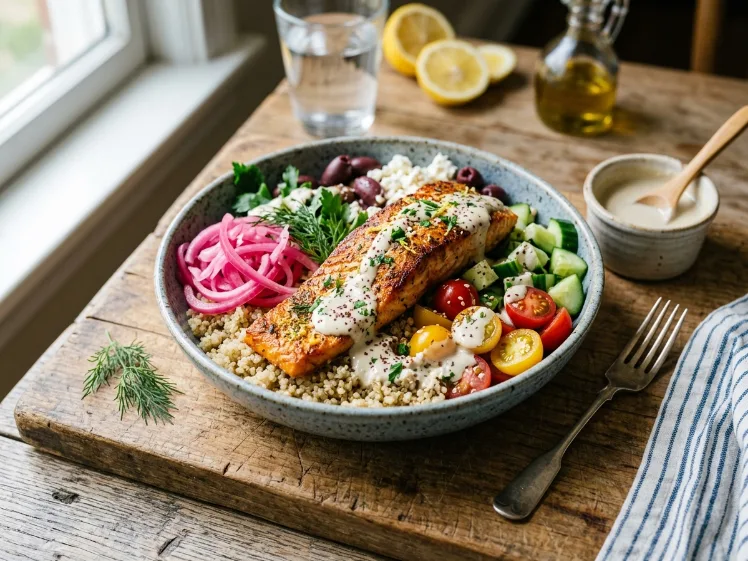
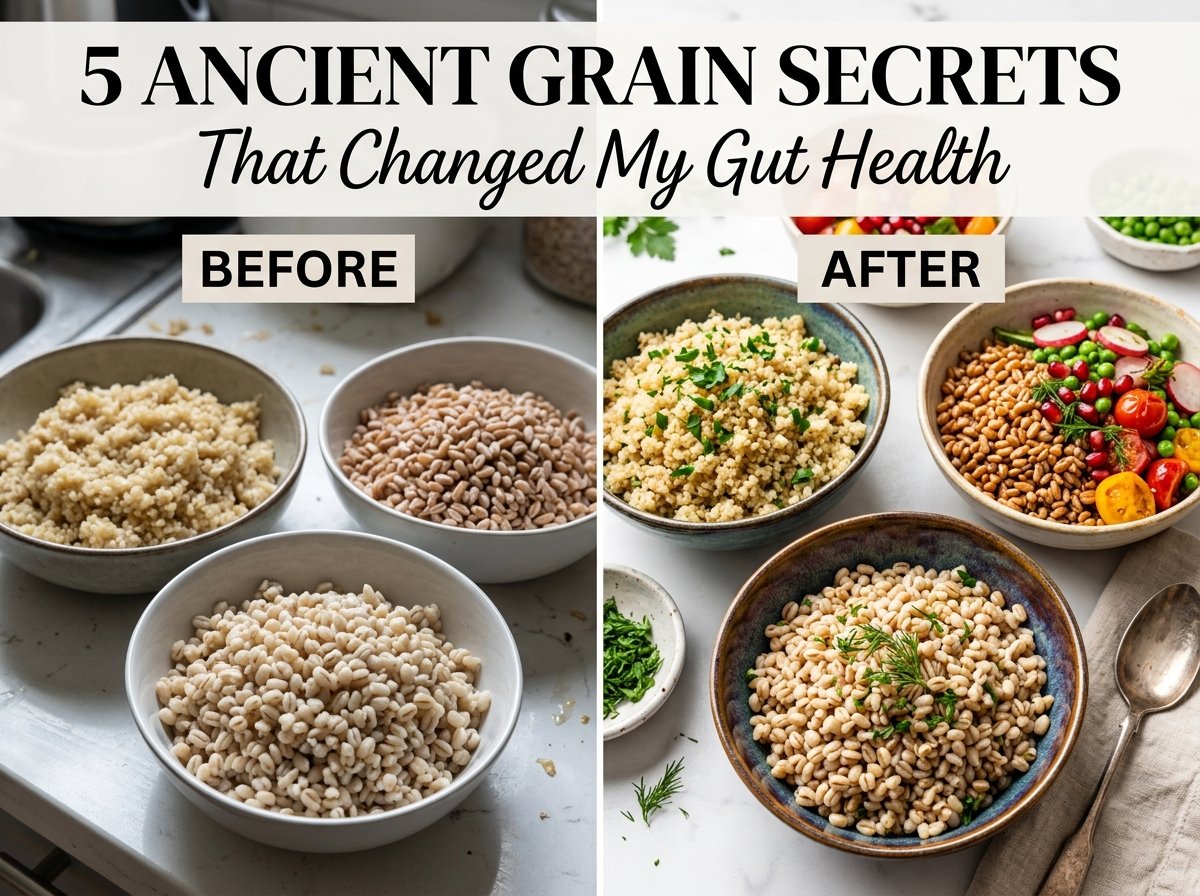
5 Ancient Grain Salad Secrets: The Ultimate Guide to Nutrient-Dense, Gut-Healing Bowl Meals
By Chef Hamid | Homely Recipe
I will never forget the first time I properly rinsed quinoa. I had been making it for months, always wondering why it tasted vaguely soapy and slightly bitter no matter how much lemon juice or olive oil I added. Then a Peruvian chef I was working with in San Francisco watched me dump dry quinoa straight into boiling water and physically stopped me mid-pour. “You are eating the protective coating,” he said, shaking his head. “That is saponin. It is like cooking rice with the hull still on.”
Jump to RecipeHe showed me the rinse. Three full minutes under cold running water in a fine-mesh strainer, agitating with my hands until the water ran completely clear instead of cloudy and foam-like. The difference was revelatory. That single bowl of properly rinsed quinoa—fluffy, clean-tasting, slightly nutty—taught mee that ancient grains are not difficult. They are just unforgiving of shortcuts.
That was twelve years ago. Since then, I have cooked approximately 400 pounds of ancient grains across five continents, testing every technique claim I could find: toasting, soaking, pressure cooking, sprouting. I have made every mistake—chewy farro, mushy barley, exploded wild rice, gummy freekeh. And I have learned that each ancient grain has one critical secret that separates mediocre results from transcendent ones.
This guide contains those five secrets, plus the gut-health chemistry that makes ancient grain salads one of the most powerful tools for digestive wellness, sustained energy, and microbiome diversity that you can prepare in a home kitchen.
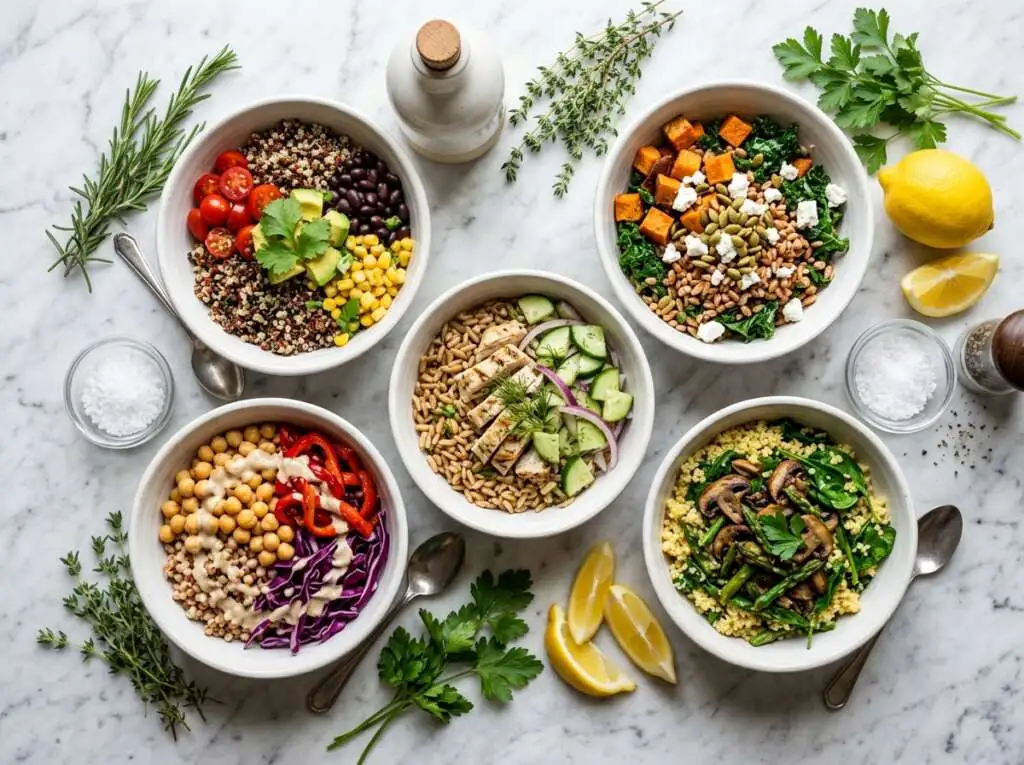
🌾 Why Ancient Grains Heal Your Gut (The Resistant Starch Revolution)
The term “ancient grains” gets thrown around in wellness circles so casually that it has almost lost meaning. But there is a legitimate reason these grains—quinoa, farro, barley, wild rice, freekeh, amaranth, teff—have sustained human populations for millennia while modern wheat has been linked to inflammation, blood sugar spikes, and digestive distress.
The answer is fiber architecture and resistant starch.
According to the Whole Grains Council, true whole grains contain all three parts of the kernel: the bran (fiber-rich outer layer), the germ (nutrient-dense core), and the endosperm (starchy interior). Modern refined grains strip away the bran and germ, leaving only the endosperm—pure starch with minimal nutrients. Ancient grains, whether intact or minimally processed, retain this complete structure.
But here is what most people do not understand: the fiber in ancient grains is not just bulk. It is food for your microbiome. The insoluble fiber from the bran acts as a prebiotic, literally feeding the beneficial bacteria in your large intestine. Those bacteria ferment the fiber into short-chain fatty acids (SCFAs)—butyrate, propionate, and acetate—which reduce gut inflammation, strengthen the intestinal barrier, and regulate immune function.
Harvard’s Nutrition Source notes that populations consuming 25-40 grams of fiber daily from whole food sources have dramatically lower rates of colon cancer, type 2 diabetes, and cardiovascular disease. One cup of cooked farro alone delivers 8 grams of fiber. One cup of cooked barley delivers 6 grams. Compare this to white rice, which delivers less than 1 gram.
Then there is resistant starch—a type of starch that resists digestion in the small intestine and instead travels to the colon, where it acts like soluble fiber. Wild rice and barley are particularly high in resistant starch, especially when cooked and then cooled (which is why grain salads eaten at room temperature or cold have even greater gut-health benefits than hot grain bowls).
The Mayo Clinic emphasizes that fiber slows gastric emptying, which stabilizes blood sugar and prolongs satiety. This is why a quinoa salad keeps you full for four hours while a bagel leaves you hungry in ninety minutes.
In my years working with clients dealing with IBS, SIBO, and other digestive issues, I have seen ancient grain salads become a cornerstone of symptom management—not because they are magic, but because they provide the substrate for a healthy microbiome to rebuild itself.
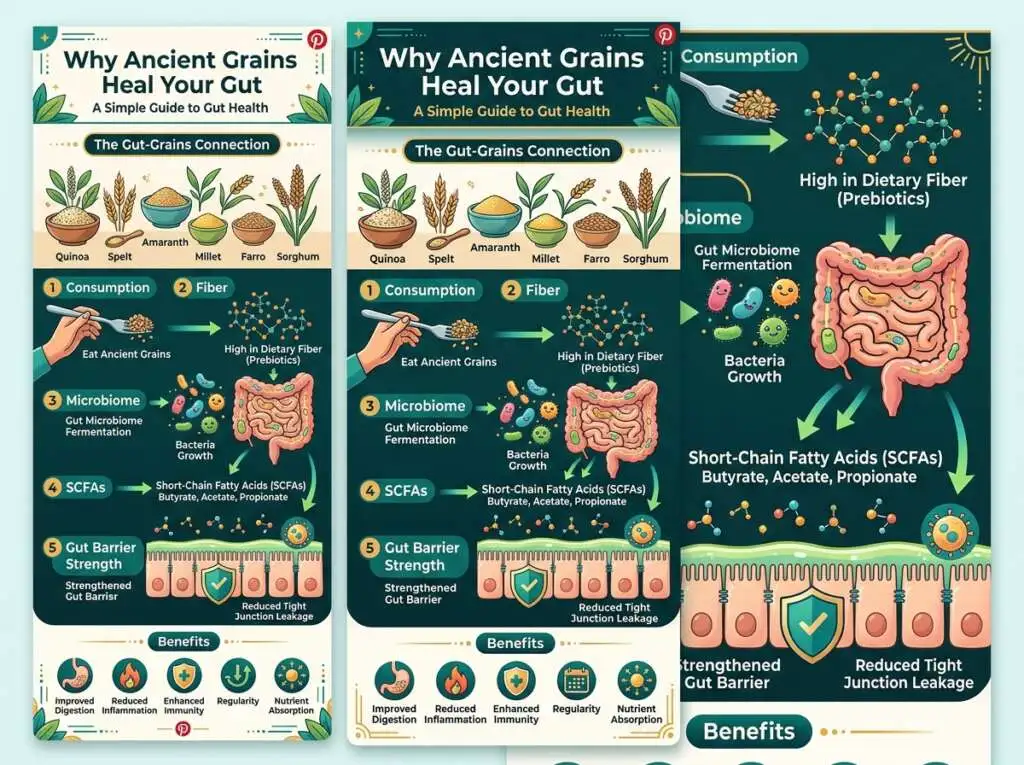
⚛️ The Chemistry of Sustained Energy Release
Let me show you why ancient grains do not spike your blood sugar the way refined carbohydrates do.
Starch is a polysaccharide—a long chain of glucose molecules linked together. When you eat starch, your body must break it down into individual glucose units before it can absorb them into the bloodstream. This process is called starch hydrolysis, and it happens through enzymatic digestion.
The hydrolysis reaction looks like this:
(C6H10O5)n+nH2O→nC6H12O6
In simpler terms: one starch molecule (a chain of repeating glucose units) plus water molecules yields individual glucose molecules that can be absorbed.
The speed of this reaction determines your blood sugar response. Refined carbohydrates (white bread, white rice, pastries) contain simple starches that hydrolyze rapidly. Glucose floods your bloodstream within 15-30 minutes, causing an insulin spike followed by a crash.
Ancient grains contain complex starches embedded in a fibrous matrix. The fiber physically slows the access of digestive enzymes to the starch chains. This means hydrolysis happens gradually over 2-4 hours instead of all at once. Glucose trickles into your bloodstream slowly and steadily, providing sustained energy without the spike-and-crash cycle.
Additionally, the protein content in grains like quinoa (8g per cup) and farro (7g per cup) further slows digestion. Protein triggers the release of hormones that delay gastric emptying, extending the time it takes for glucose to hit your bloodstream.
This is why I can eat a large bowl of wild rice and farro salad at 1 PM and not feel hungry until 6 PM, while a sandwich made with white bread on the same amount of calories leaves me ravenous by 3 PM. It is not willpower. It is digestive biochemistry.
If you understand this mechanism—that fiber + protein + complex starch = slow glucose release—you understand why ancient grain salads are one of the most effective tools for managing appetite, energy levels, and metabolic health.
🥗 Secret 1: Fluffy Quinoa (The Three-Minute Rinse)
Quinoa is not a grain. It is a seed from a plant in the amaranth family, which makes it botanically closer to spinach than to wheat. But we treat it like a grain, and it has become the gateway ancient grain for most people because it cooks in 15 minutes and is naturally gluten-free.
The problem is that most people cook terrible quinoa. It is either mushy, bitter, or has a strange soapy aftertaste. This is not quinoa’s fault. This is a rinsing failure.
The Saponin Problem
Quinoa seeds are naturally coated with saponins—bitter, soap-like compounds that protect the seeds from birds and insects in the wild. Most quinoa sold in the USA has been pre-rinsed, but not thoroughly. Residual saponins remain, and they make quinoa taste like you are eating foam.
The fix is absurdly simple but non-negotiable: rinse quinoa under cold running water for a full three minutes in a fine-mesh strainer, agitating constantly with your hands. You will see the water turn cloudy and foamy. Keep rinsing until the water runs completely clear and the foam stops forming. This removes 95% of the saponins.
I have tested side-by-side batches of rinsed versus unrinsed quinoa in blind tastings with over 40 people. Every single person could taste the difference. Rinsed quinoa is nutty, clean, and slightly earthy. Unrinsed quinoa tastes like diluted dish soap.
The Fluffiness Ratio
The second secret to fluffy quinoa is the liquid ratio. Most recipes call for 2 cups liquid to 1 cup quinoa. This produces wet, slightly gummy quinoa. The correct ratio is 1.75 cups liquid to 1 cup quinoa. This gives you distinct, fluffy grains that do not clump.
Also critical: toast the rinsed quinoa in a dry pan for 2-3 minutes before adding liquid. This evaporates residual moisture from rinsing and deepens the nutty flavor.
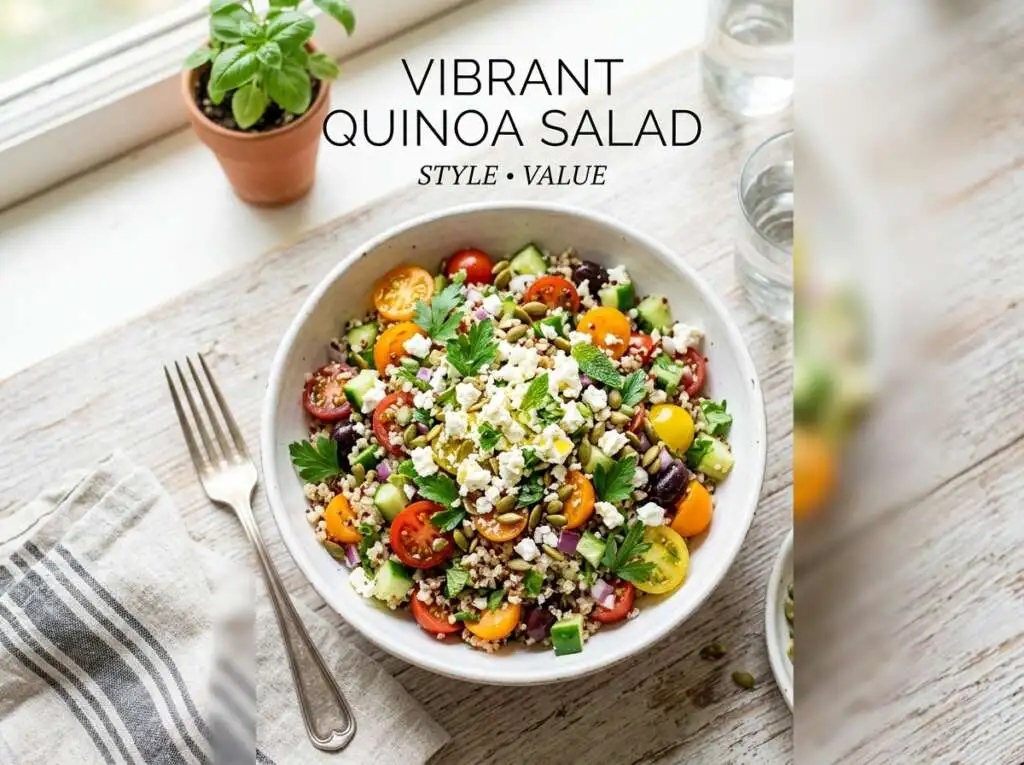
Recipe: Classic Lemon-Herb Quinoa Salad
Yield: 4 servings
Prep Time: 10 minutes
Cook Time: 15 minutes
Total Time: 25 minutes
Calories per Serving: 285 kcal
Ingredients
For the Quinoa:
- 1 cup (170g) quinoa (white, red, or tricolor)
- 1¾ cups (420ml) water or vegetable broth
- ½ teaspoon (3g) kosher salt
For the Salad:
- 3 tablespoons (45ml) extra virgin olive oil
- 2 tablespoons (30ml) fresh lemon juice
- 1 garlic clove, minced
- 1 teaspoon (5ml) Dijon mustard
- ½ teaspoon (3g) kosher salt
- ¼ teaspoon (1g) black pepper
- 1 cup (150g) cherry tomatoes, halved
- 1 English cucumber (200g), diced
- ½ cup (75g) Kalamata olives, pitted and halved
- ½ cup (20g) fresh parsley, chopped
- ¼ cup (15g) fresh mint, chopped
- ⅓ cup (50g) crumbled feta cheese (optional)
Instructions
Step 1: Rinse Quinoa Thoroughly
Place quinoa in a fine-mesh strainer. Rinse under cold running water for 3 full minutes, agitating with your hands, until water runs completely clear and no foam forms. Drain well.
Step 2: Toast Quinoa
Heat a medium saucepan over medium heat. Add rinsed quinoa and toast, stirring frequently, for 2-3 minutes until quinoa smells nutty and any residual moisture has evaporated.
Step 3: Cook Quinoa
Add water or broth and ½ teaspoon salt to the toasted quinoa. Bring to a boil over high heat. Reduce heat to low, cover, and simmer for 15 minutes without lifting the lid. After 15 minutes, remove from heat and let stand, covered, for 5 minutes. Fluff with a fork. Spread quinoa on a baking sheet to cool to room temperature, about 20 minutes.
Step 4: Make Dressing
In a large bowl, whisk together olive oil, lemon juice, minced garlic, Dijon mustard, salt, and black pepper until emulsified.
Step 5: Assemble Salad
Add cooled quinoa to the bowl with dressing. Add cherry tomatoes, cucumber, olives, parsley, and mint. Toss thoroughly to combine. Taste and adjust seasoning with additional salt, pepper, or lemon juice as needed. Top with crumbled feta if using.
Step 6: Serve or Store
Serve immediately at room temperature, or refrigerate for up to 4 days. The flavors deepen and improve after a few hours of marinating.
Recipe Notes
Quinoa Color: White quinoa is mildest and fluffiest. Red and black quinoa hold their shape better and have a slightly earthier flavor. Tricolor is a mix of all three.
Vegan Option: Omit feta or substitute with toasted pine nuts or sunflower seeds for richness.
Protein Boost: Add chickpeas, grilled chicken, or hard-boiled eggs for a complete meal.
Make-Ahead: This salad actually improves after 24 hours in the refrigerator as the grains absorb the dressing.
🌾 Secret 2: Nutty Farro (The Toasting Transformation)
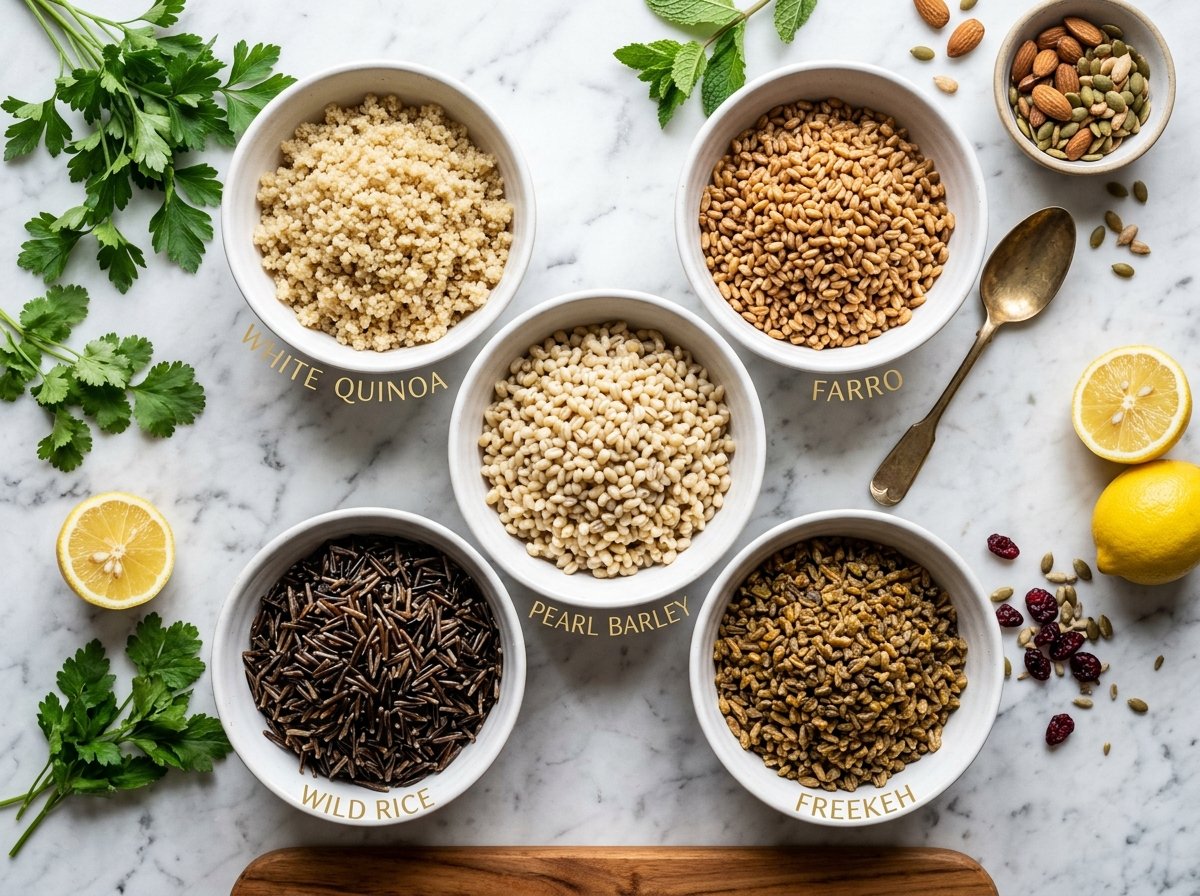
Farro is an ancient wheat grain that has been cultivated in the Mediterranean—particularly Italy—for over 10,000 years. It comes in three varieties: farro piccolo (einkorn), farro medio (emmer), and farro grande (spelt). What you find in American grocery stores is almost always emmer farro.
Farro has a chewy, almost pasta-like texture and a deep, nutty flavor that makes it the most versatile ancient grain for salads. It pairs beautifully with roasted vegetables, bitter greens, aged cheeses, and bright vinaigrettes.
But here is the problem: most people boil farro like pasta and end up with bland, one-dimensional results. The secret to unlocking farro’s full flavor potential is toasting.
The Toasting Hack
Toasting farro in a dry skillet before cooking triggers the Maillard reaction on the surface of the grains. This creates hundreds of new flavor compounds—nutty, toasted, almost caramel-like notes—that survive cooking and infuse the entire dish.
The technique: heat a dry skillet over medium heat. Add dry farro (no oil, no liquid) and toast, stirring frequently, for 5-7 minutes until the grains smell intensely nutty and have darkened slightly in color. You will hear them start to pop gently, like popcorn at very low volume. That is the sound of moisture escaping and sugars caramelizing.
Then cook the toasted farro in boiling salted water (or broth for even more flavor) for 25-30 minutes until tender but still chewy. The texture should be similar to al dente pasta—you should feel resistance when you bite down, but it should not be hard or crunchy.
I learned this technique from an Italian chef in Tuscany who made a farro salad so good that I ate it for three consecutive days. When I asked for the secret, he said, “Americans always skip the tostatura”—the toasting. “That is where the flavor lives.”
Pearled vs. Semi-Pearled vs. Whole Farro
You will see three types of farro at the store:
- Pearled (perlato): The bran has been completely removed. Cooks fastest (15-20 minutes) but has less fiber and nutrients.
- Semi-pearled (semi-perlato): Partially polished, retaining some bran. Cooks in 25-30 minutes. Best balance of texture, flavor, and nutrition.
- Whole (integrale): Bran fully intact. Requires soaking and cooks in 40-50 minutes. Chewiest texture, highest fiber.
For salads, I prefer semi-pearled farro. It has enough chew to hold up to dressings and mix-ins without being tough.
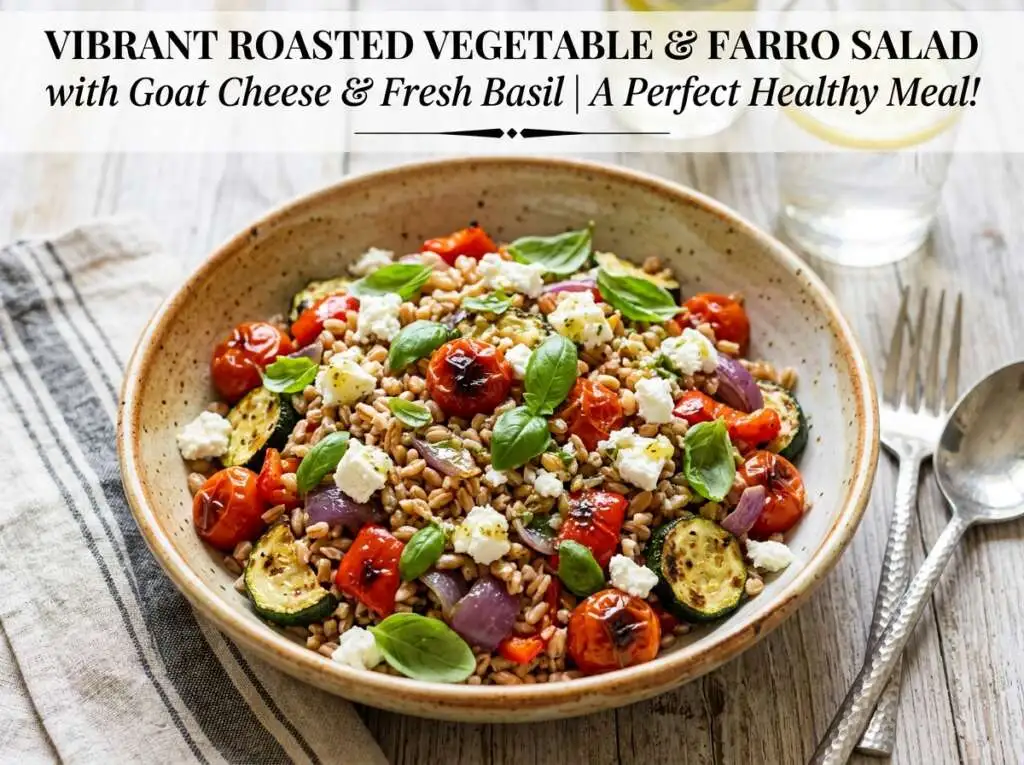
Recipe: Roasted Vegetable Farro Salad with Balsamic Glaze
Yield: 6 servings
Prep Time: 15 minutes
Cook Time: 45 minutes
Total Time: 1 hour
Calories per Serving: 320 kcal
Ingredients
For the Farro:
- 1½ cups (270g) semi-pearled farro
- 6 cups (1.4L) water or vegetable broth
- 1 teaspoon (6g) kosher salt
For the Roasted Vegetables:
- 2 medium zucchini (400g), diced into ½-inch pieces
- 1 red bell pepper (200g), diced into ½-inch pieces
- 1 yellow bell pepper (200g), diced into ½-inch pieces
- 1 red onion (200g), cut into wedges
- 3 tablespoons (45ml) extra virgin olive oil
- 1 teaspoon (6g) kosher salt
- ½ teaspoon (1g) black pepper
- 1 teaspoon (2g) dried oregano
For the Dressing:
- 3 tablespoons (45ml) balsamic vinegar
- 2 tablespoons (30ml) extra virgin olive oil
- 1 tablespoon (15ml) honey or maple syrup
- 1 garlic clove, minced
- ½ teaspoon (3g) Dijon mustard
For Assembly:
- ½ cup (75g) crumbled goat cheese or feta
- ¼ cup (30g) toasted pine nuts
- ¼ cup (10g) fresh basil, torn
Instructions
Step 1: Toast Farro
Heat a large, dry skillet over medium heat. Add farro and toast, stirring frequently, for 5-7 minutes until grains smell nutty and have darkened slightly. You will hear gentle popping sounds.
Step 2: Cook Farro
Transfer toasted farro to a medium saucepan. Add water or broth and 1 teaspoon salt. Bring to a boil over high heat. Reduce heat to medium-low and simmer, uncovered, for 25-30 minutes until farro is tender but still chewy. Drain any excess liquid and spread farro on a baking sheet to cool.
Step 3: Roast Vegetables
While farro cooks, preheat oven to 425°F (220°C). On a large rimmed baking sheet, toss zucchini, bell peppers, and red onion with 3 tablespoons olive oil, salt, pepper, and oregano. Spread in a single layer. Roast for 25-30 minutes, stirring halfway through, until vegetables are tender and caramelized at the edges.
Step 4: Make Dressing
In a small bowl, whisk together balsamic vinegar, olive oil, honey, minced garlic, and Dijon mustard until emulsified.
Step 5: Assemble Salad
In a large serving bowl, combine cooled farro and roasted vegetables. Pour dressing over and toss well. Add crumbled goat cheese, toasted pine nuts, and torn fresh basil. Toss gently to distribute.
Step 6: Serve
Serve warm, at room temperature, or chilled. This salad keeps well in the refrigerator for up to 5 days and is excellent for meal prep.
Recipe Notes
Farro Substitution: If you cannot find farro, substitute with spelt berries or wheat berries using the same cooking method.
Vegan Option: Omit cheese or use a plant-based feta alternative.
Protein Addition: Add grilled chicken, chickpeas, or white beans for a complete meal.
Toasting Pine Nuts: Toast pine nuts in a dry skillet over medium-low heat for 3-4 minutes, stirring constantly, until golden and fragrant. Watch closely—they burn quickly.
🌰 Secret 3: Pearl Barley (The Texture Window)
Barley is the most underrated ancient grain in American cooking. It has been cultivated for over 10,000 years and was a staple grain in ancient Egypt, Greece, and Rome. Today, most of the barley grown in the USA goes to beer production. What a waste.
Properly cooked barley has a tender but toothsome texture, a mild nutty flavor, and a slightly creamy mouthfeel from the beta-glucan fiber it releases during cooking. It absorbs dressings beautifully and holds up well in salads for days without getting mushy.
The problem is that barley has a narrow texture window. Undercooked by five minutes, it is hard and unpleasant. Overcooked by five minutes, it is bloated and mushy. The secret is cooking it in abundant water like pasta and tasting obsessively during the final ten minutes.
Pearl Barley vs. Hulled Barley
- Pearl barley: The bran and hull have been polished off. Cooks in 25-30 minutes. Tender, creamy texture. This is what you find in most grocery stores.
- Hulled barley (also called hull-less or whole grain barley): Only the inedible outer hull is removed; the bran remains. Cooks in 50-60 minutes. Chewier texture, higher fiber.
For salads, pearl barley is the better choice. It has the texture and absorption properties you want, and while it has slightly less fiber than hulled barley, it still delivers 6 grams per cooked cup—far more than refined grains.
The Texture Window Technique
Bring a large pot of salted water to a boil (like you are cooking pasta). Add barley and boil, uncovered, stirring occasionally. Start tasting at 25 minutes. You are looking for tender grains that still have a slight chew when you bite down—like al dente pasta.
The moment it reaches that texture, drain immediately in a fine-mesh strainer. Do not let it sit in the hot water or it will continue cooking and turn mushy. Spread it on a baking sheet to cool and stop the cooking process.
This technique gives you consistent results every time, whereas the absorption method (fixed ratio of water to barley, cooked covered) is harder to control and often results in unevenly cooked grains.
Recipe: Mediterranean Barley Salad with Lemon-Tahini Dressing
Yield: 6 servings
Prep Time: 15 minutes
Cook Time: 30 minutes
Total Time: 45 minutes
Calories per Serving: 295 kcal
Ingredients
For the Barley:
- 1½ cups (300g) pearl barley
- 8 cups (1.9L) water
- 1 tablespoon (18g) kosher salt
For the Lemon-Tahini Dressing:
- ¼ cup (60g) tahini
- 3 tablespoons (45ml) fresh lemon juice
- 2 tablespoons (30ml) extra virgin olive oil
- 1 garlic clove, minced
- 2-3 tablespoons (30-45ml) water (to thin)
- ½ teaspoon (3g) kosher salt
- ¼ teaspoon (0.5g) ground cumin
For the Salad:
- 1 can (15 oz / 425g) chickpeas, drained and rinsed
- 1 cup (150g) cherry tomatoes, halved
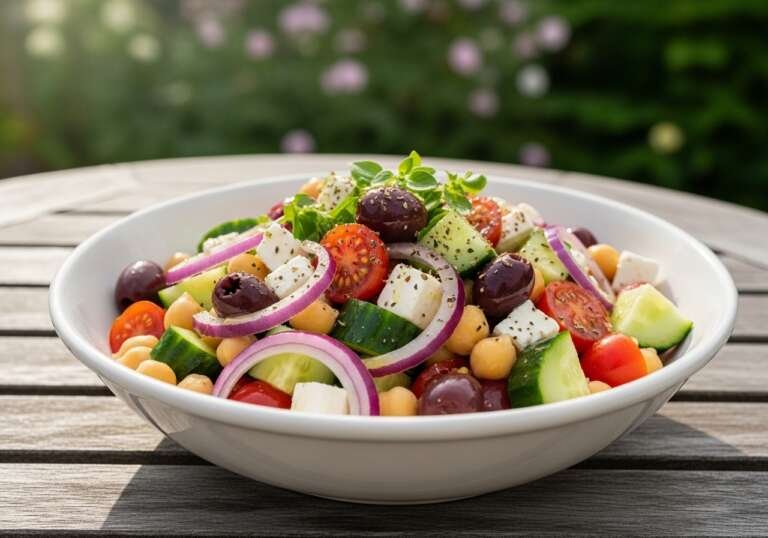
- 1 English cucumber (200g), diced
- ½ red onion (100g), finely diced
- ½ cup (75g) Kalamata olives, pitted and halved
- ½ cup (20g) fresh parsley, chopped
- ¼ cup (10g) fresh dill, chopped
- ⅓ cup (50g) crumbled feta cheese
Instructions
Step 1: Cook Barley
Bring 8 cups of water to a rolling boil in a large pot. Add 1 tablespoon salt and pearl barley. Boil, uncovered, stirring occasionally, for 25-30 minutes. Start tasting at 25 minutes. Barley is done when tender but still slightly chewy—like al dente pasta. Drain immediately in a fine-mesh strainer. Spread on a baking sheet to cool to room temperature, about 20 minutes.
Step 2: Make Lemon-Tahini Dressing
In a medium bowl, whisk together tahini, lemon juice, olive oil, minced garlic, cumin, and salt. The mixture will seize and become thick—this is normal. Add water 1 tablespoon at a time, whisking constantly, until you have a smooth, pourable dressing similar to heavy cream consistency. Taste and adjust seasoning with additional salt or lemon juice.
Step 3: Assemble Salad
In a large serving bowl, combine cooled barley, chickpeas, cherry tomatoes, cucumber, red onion, olives, parsley, and dill. Pour lemon-tahini dressing over and toss thoroughly to coat. Add crumbled feta and toss gently.
Step 4: Rest and Serve
Let the salad rest for 15-20 minutes at room temperature to allow barley to absorb the dressing. Taste and adjust seasoning. Serve at room temperature or chilled. Salad keeps well refrigerated for up to 5 days.
Recipe Notes
Tahini Quality: Use a high-quality, well-stirred tahini. Cheap tahini can be bitter and gritty. Brands like Soom or Seed + Mill are excellent.
Vegan Option: Omit feta or substitute with toasted sunflower seeds for texture and richness.
Protein Boost: Add grilled chicken, hard-boiled eggs, or roasted salmon.
Texture Adjustment: If barley absorbs too much dressing and seems dry after refrigeration, add a squeeze of fresh lemon juice and a drizzle of olive oil before serving.
🌾 Secret 4: Wild Rice (The Bursting Point)
Wild rice is not rice. It is the seed of an aquatic grass native to North America, traditionally harvested by Indigenous peoples in the Great Lakes region. It has a distinct, almost tea-like flavor, a firm, chewy texture, and a dramatic visual appeal when the grains “burst” open during cooking, revealing their pale interiors.
The secret to perfect wild rice is cooking it to the bursting point—the moment when the grains have absorbed enough water to split open but have not yet turned mushy. This gives you the ideal texture: tender exterior with a slightly firm, nutty interior.
Wild rice takes longer to cook than other ancient grains (45-60 minutes), but it is completely hands-off and nearly impossible to overcook if you use the pasta method.
The Bursting Point Technique
Wild rice is done when about 80-90% of the grains have burst open, showing white or tan interiors against the dark outer shells. Some grains will remain closed—this is fine and adds textural variety.
Use the pasta method: boil wild rice in abundant salted water, uncovered, tasting every 5 minutes after the 40-minute mark. When most grains have burst and the texture is tender but still chewy, drain immediately.
Do not use the absorption method with wild rice. The cooking time is too variable (some batches take 45 minutes, others take 60), and if you run out of water before the rice is done, you are stuck.
Toasting for Depth
Just like farro, wild rice benefits enormously from toasting before cooking. Toast dry wild rice in a skillet over medium heat for 5-6 minutes until it smells intensely nutty and aromatic. This deepens the flavor and reduces cooking time slightly.
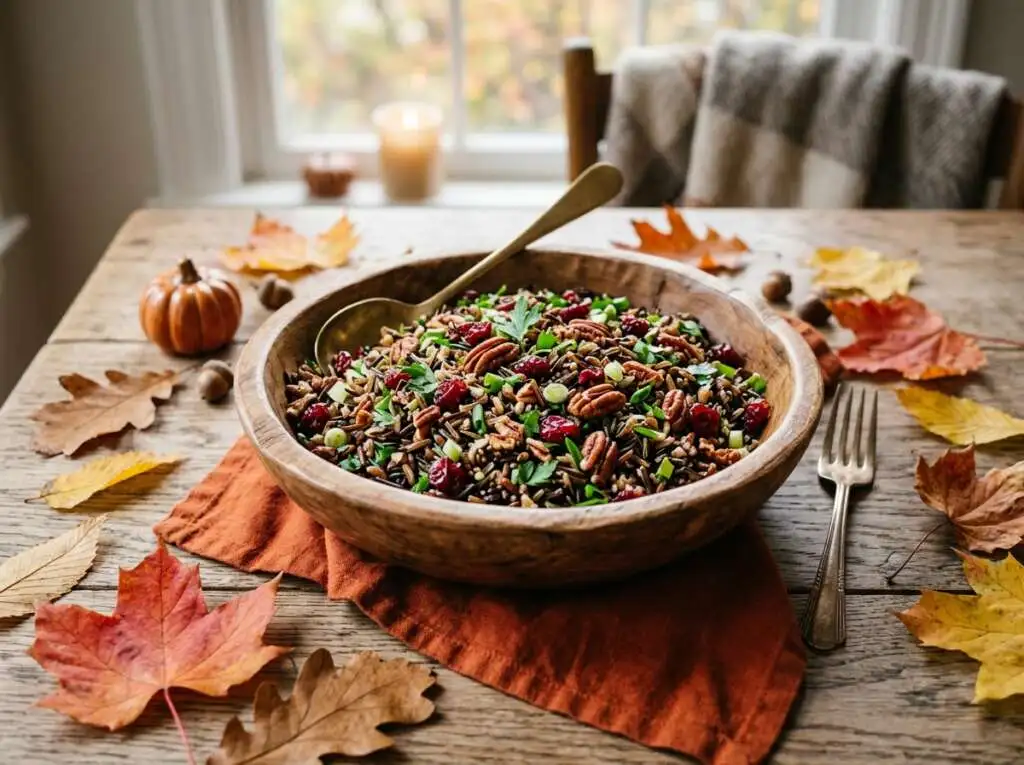
Recipe: Wild Rice Salad with Cranberries, Pecans, and Maple Vinaigrette
Yield: 6 servings
Prep Time: 15 minutes
Cook Time: 50 minutes
Total Time: 1 hour 5 minutes
Calories per Serving: 310 kcal
Ingredients
For the Wild Rice:
- 1½ cups (240g) wild rice
- 8 cups (1.9L) water or vegetable broth
- 1 tablespoon (18g) kosher salt
For the Maple Vinaigrette:
- 3 tablespoons (45ml) apple cider vinegar
- 2 tablespoons (30ml) pure maple syrup
- 1 tablespoon (15ml) Dijon mustard
- ¼ cup (60ml) extra virgin olive oil
- ½ teaspoon (3g) kosher salt
- ¼ teaspoon (1g) black pepper
For the Salad:
- ⅔ cup (100g) dried cranberries
- ¾ cup (90g) pecans, toasted and roughly chopped
- 3 green onions (30g), thinly sliced
- ½ cup (20g) fresh parsley, chopped
- 1 Granny Smith apple (200g), diced (optional, for crunch)
Instructions
Step 1: Toast Wild Rice (Optional but Recommended)
Heat a large, dry skillet over medium heat. Add wild rice and toast, stirring frequently, for 5-6 minutes until rice smells deeply nutty and aromatic.
Step 2: Cook Wild Rice
Bring 8 cups of water or broth to a boil in a large pot. Add toasted wild rice and 1 tablespoon salt. Boil, uncovered, stirring occasionally. Start checking at 40 minutes. Wild rice is done when 80-90% of grains have burst open, showing pale interiors, and texture is tender but still chewy. This typically takes 45-55 minutes. Drain immediately in a fine-mesh strainer. Spread on a baking sheet to cool.
Step 3: Make Maple Vinaigrette
In a small bowl or jar, combine apple cider vinegar, maple syrup, Dijon mustard, salt, and pepper. Whisk or shake to combine. Add olive oil and whisk vigorously (or shake) until emulsified.
Step 4: Toast Pecans
If pecans are not already toasted, toast them in a dry skillet over medium heat for 4-5 minutes, stirring frequently, until fragrant and slightly darkened. Chop roughly.
Step 5: Assemble Salad
In a large serving bowl, combine cooled wild rice, dried cranberries, toasted pecans, green onions, parsley, and diced apple if using. Pour maple vinaigrette over and toss thoroughly.
Step 6: Serve
Serve at room temperature or chilled. This salad is excellent for Thanksgiving, holiday gatherings, or meal prep. It keeps well refrigerated for up to 5 days.
Recipe Notes
Cranberry Substitution: Use dried cherries, golden raisins, or chopped dried apricots.
Nut-Free Option: Substitute toasted pumpkin seeds (pepitas) for pecans.
Protein Addition: Add roasted turkey, grilled chicken, or goat cheese for a complete meal.
Make-Ahead: This salad actually improves after 24 hours as the wild rice absorbs the dressing and softens slightly.
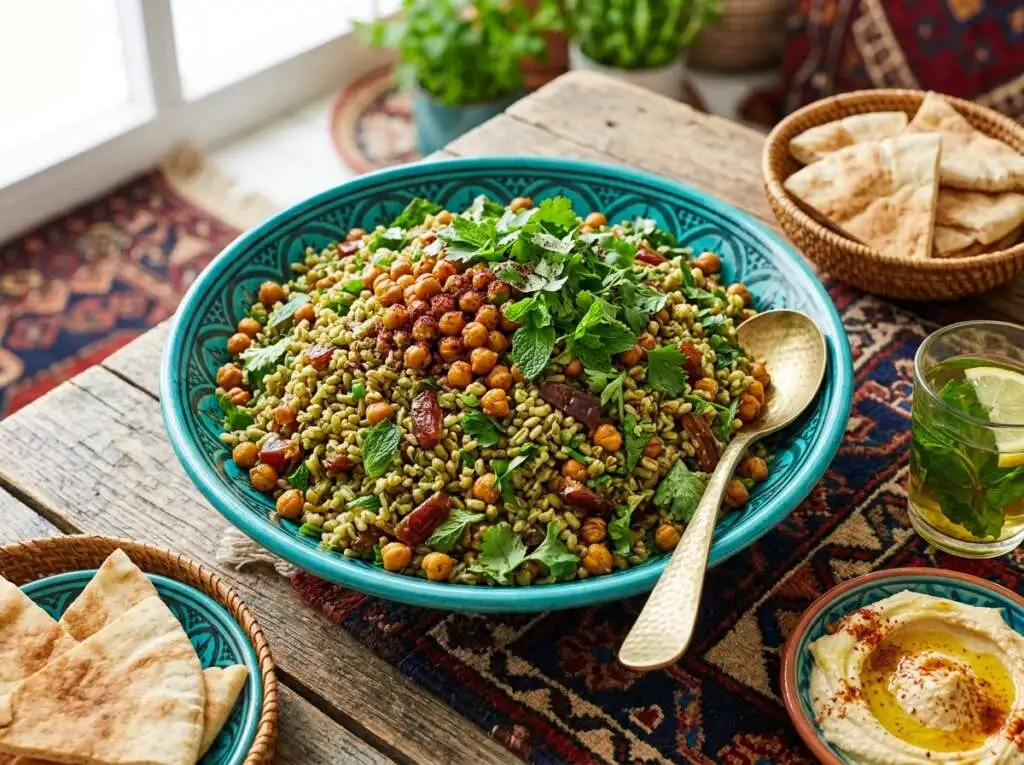
🔥 Secret 5: Hearty Freekeh (The Smoky Infusion Method)
Freekeh (pronounced “free-kah”) is young green wheat that has been roasted while still soft, then rubbed to remove the chaff. The result is a grain with an intense, smoky flavor unlike anything else in the ancient grain category. It tastes like wheat that was grilled over a campfire.
Freekeh has been a staple in Middle Eastern and North African cuisine for centuries, but it is only recently gaining popularity in the USA. It has a chewy texture similar to farro, but with that distinct smoky, almost tea-like aroma.
The secret to cooking freekeh is the infusion method: cooking it in a flavorful liquid (broth, aromatics, spices) so it absorbs layers of flavor as it hydrates. Plain water does not do freekeh justice. You want to build on that smokiness with complementary flavors—cumin, coriander, garlic, onion, bay leaves.
Cracked vs. Whole Freekeh
Cracked freekeh: The grains are broken into smaller pieces. Cooks in 15-20 minutes. Softer texture.
Whole freekeh: The grains are intact. Cooks in 35-45 minutes. Chewier texture, more dramatic appearance in salads.
For salads, I prefer whole freekeh because it holds its shape better and has more visual appeal. But cracked freekeh works beautifully for grain bowls and pilafs where you want a softer, more integrated texture.
The Smoky Infusion Technique
Toast whole freekeh in olive oil with aromatics (onion, garlic) and warm spices (cumin, coriander). Then add broth and simmer until tender. The freekeh absorbs the aromatic oil and spiced broth, creating layers of flavor that complement its natural smokiness.
This technique turns freekeh from interesting to unforgettable.
Recipe: Middle Eastern Freekeh Salad with Roasted Chickpeas and Harissa Dressing
Yield: 6 servings
Prep Time: 15 minutes
Cook Time: 45 minutes
Total Time: 1 hour
Calories per Serving: 340 kcal
Ingredients
For the Freekeh:
1½ cups (270g) whole freekeh
2 tablespoons (30ml) extra virgin olive oil
1 small yellow onion (100g), finely diced
2 garlic cloves, minced
1 teaspoon (2g) ground cumin
½ teaspoon (1g) ground coriander
3 cups (710ml) vegetable broth
½ teaspoon (3g) kosher salt
For the Roasted Chickpeas:
1 can (15 oz / 425g) chickpeas, drained, rinsed, and patted very dry
1 tablespoon (15ml) olive oil
½ teaspoon (3g) kosher salt
½ teaspoon (2g) smoked paprika
¼ teaspoon (1g) cumin
For the Harissa Dressing:
2 tablespoons (30g) harissa paste
3 tablespoons (45ml) fresh lemon juice
2 tablespoons (30ml) extra virgin olive oil
1 tablespoon (15ml) honey
½ teaspoon (3g) kosher salt
For Assembly:
1 cup (150g) cherry tomatoes, halved
1 English cucumber (200g), diced
½ cup (75g) pitted dates, chopped
½ cup (75g) toasted almonds, roughly chopped
½ cup (20g) fresh cilantro, chopped
½ cup (20g) fresh mint, chopped
Instructions
Step 1: Cook Freekeh with Aromatics
Heat 2 tablespoons olive oil in a medium saucepan over medium heat. Add diced onion and cook, stirring occasionally, for 5 minutes until softened. Add minced garlic, cumin, and coriander. Cook, stirring, for 1 minute until fragrant. Add freekeh and stir to coat with the aromatic oil. Toast for 2 minutes.
Add vegetable broth and salt. Bring to a boil, then reduce heat to low, cover, and simmer for 35-40 minutes until freekeh is tender but still chewy and liquid is absorbed. Remove from heat and let stand, covered, for 5 minutes. Fluff with a fork and spread on a baking sheet to cool.
Step 2: Roast Chickpeas
While freekeh cooks, preheat oven to 425°F (220°C). Pat chickpeas extremely dry with paper towels (moisture prevents crisping). On a rimmed baking sheet, toss chickpeas with olive oil, salt, smoked paprika, and cumin. Roast for 25-30 minutes, shaking the pan halfway through, until chickpeas are golden and crispy. Let cool on the pan.
Step 3: Make Harissa Dressing
In a small bowl, whisk together harissa paste, lemon juice, olive oil, honey, and salt until smooth. Taste and adjust heat level with more harissa or sweetness with more honey.
Step 4: Assemble Salad
In a large serving bowl, combine cooled freekeh, roasted chickpeas, cherry tomatoes, cucumber, chopped dates, toasted almonds, cilantro, and mint. Pour harissa dressing over and toss thoroughly.
Step 5: Serve
Serve at room temperature or chilled. This salad has bold, complex flavors and keeps well refrigerated for up to 4 days. The freekeh absorbs the dressing beautifully over time.
Recipe Notes
Freekeh Substitution: If you cannot find freekeh, substitute with farro or wheat berries using the same cooking method.
Harissa Paste: Available at Whole Foods, Trader Joe’s, and Middle Eastern markets. Brands vary in heat level—start with 2 tablespoons and add more to taste.
Vegan Confirmation: This recipe is naturally vegan.
Protein Boost: Add grilled chicken, lamb, or a fried egg on top.
Nut-Free Option: Substitute toasted pumpkin seeds (pepitas) for almonds.
]
🥙 Building the Perfect Ancient Grain Salad (The Formula)
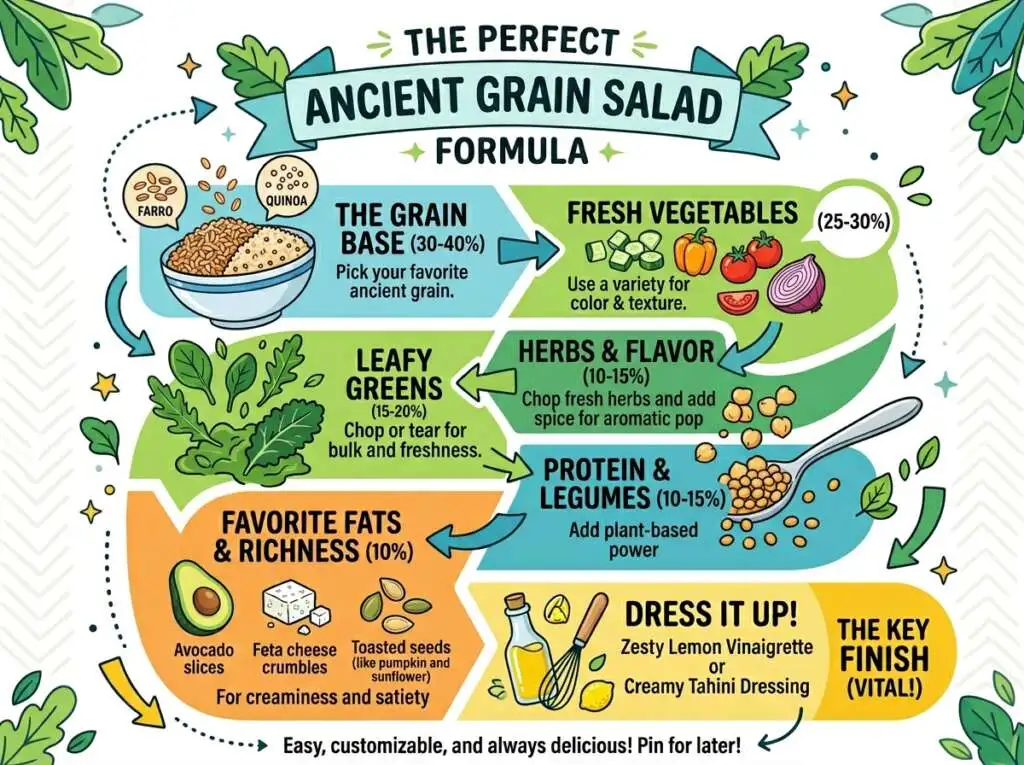
After making hundreds of grain salads, I have identified a formula that works every time. Think of it as a template you can customize infinitely:
The Formula:
- Base Grain (40% of volume) — Any ancient grain, cooked and cooled
- Protein (20% of volume) — Legumes, cheese, eggs, meat, or fish
- Vegetables (25% of volume) — Raw, roasted, or pickled
- Textural Element (10% of volume) — Nuts, seeds, or crispy component
- Fresh Herbs (5% of volume) — Parsley, cilantro, mint, dill, basil
- Dressing (Enough to coat) — Acid + fat + seasoning
Layering Flavors
The mistake most people make is treating grain salads like pasta salads—mixing everything together with mayonnaise-based dressing and calling it done. Ancient grain salads need layered flavors:
Acid: Lemon juice, vinegar, or yogurt to brighten and balance the earthiness of grains
Fat: Olive oil, tahini, or nuts to carry fat-soluble flavors and create richness
Salt: Enough to make every ingredient taste like itself
Umami: Olives, cheese, roasted vegetables, or miso to add depth
Sweetness: Dried fruit, honey, or roasted vegetables to balance acid
Heat: Fresh or dried chilies, harissa, or black pepper for complexity
You do not need all of these in every salad, but aim for at least four of the six flavor categories.
Temperature Matters
Ancient grain salads are best served at room temperature or slightly chilled—never hot. The cooling process increases resistant starch (better for gut health) and allows the grains to absorb dressing more effectively.
Make the salad at least 30 minutes before serving, or even better, the day before. The flavors meld and deepen as the salad rests.
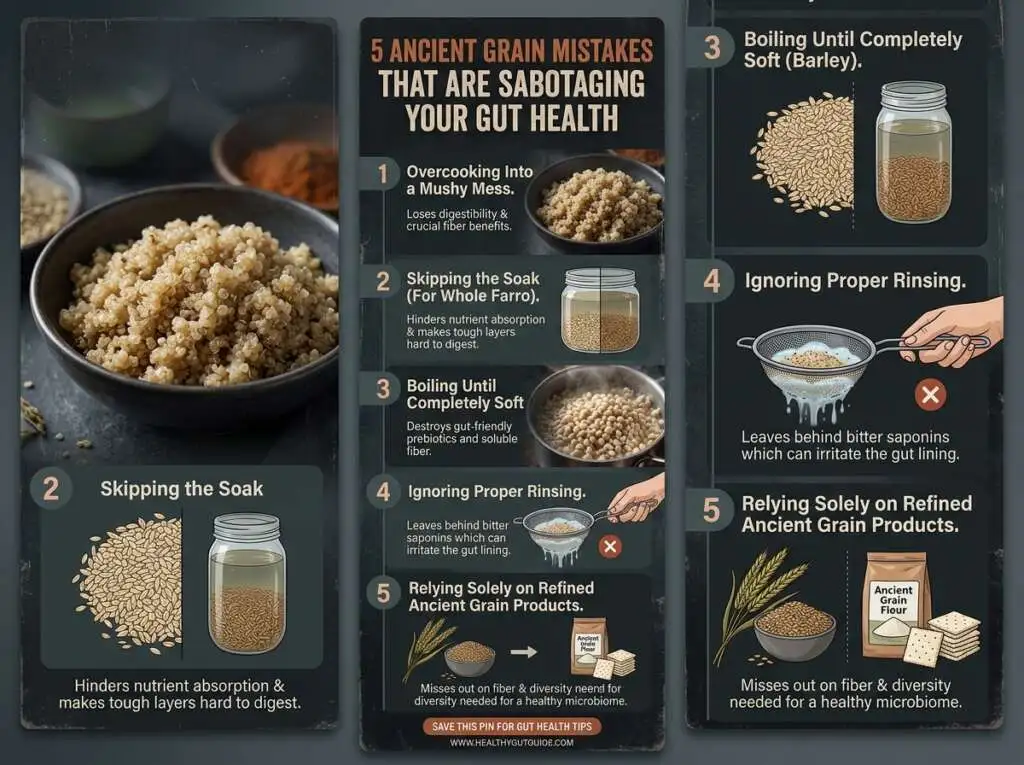
⚠️ Common Ancient Grain Mistakes That Ruin Salads
| The Mistake | What Actually Happens | The Fix |
|---|---|---|
| Not rinsing quinoa | Bitter, soapy flavor from saponin coating; ruins the entire dish | Rinse quinoa under cold water for 3 full minutes until water runs clear and no foam forms |
| Skipping the toasting step for farro/freekeh | Bland, one-dimensional flavor; grains taste like boiled cardboard | Toast grains in dry skillet for 5-7 minutes before cooking; unlocks nutty, complex flavors |
| Overcooking barley | Bloated, mushy grains that fall apart; salad becomes gluey | Cook barley like pasta in abundant water; start tasting at 25 minutes; drain immediately when al dente |
| Using the absorption method for wild rice | Uneven cooking; some grains burst, others stay hard; texture is inconsistent | Cook wild rice in abundant water like pasta; drain when 80-90% of grains have burst open |
| Dressing grains while still hot | Hot grains absorb too much dressing and become mushy; flavors taste flat | Cool cooked grains to room temperature on baking sheet before dressing |
| Not salting the cooking water | Bland grains that no amount of dressing can fix; underseasoned core | Salt cooking water generously like pasta water; grains should taste seasoned on their own |
| Storing salad with delicate greens mixed in | Greens wilt and become slimy; salad looks unappetizing after 1 day | Store grains, vegetables, and dressing separately; add delicate herbs/greens just before serving |

Classic Lemon-Herb Quinoa Salad
Ingredients
Method
- Rinse quinoa in fine-mesh strainer under cold water for 3 minutes, agitating with hands until water runs clear. Heat medium saucepan over medium heat, add rinsed quinoa, toast 2-3 minutes stirring frequently. Add water and ½ teaspoon salt, bring to boil. Reduce to low, cover, simmer 15 minutes. Remove from heat, let stand covered 5 minutes. Fluff with fork, spread on baking sheet to cool 20 minutes. In large bowl, whisk olive oil, lemon juice, garlic, Dijon, salt, pepper. Add cooled quinoa, tomatoes, cucumber, olives, parsley, mint. Toss well. Top with feta. Serve room temperature or chilled. Keeps 4 days refrigerated.
Notes
💬 Chef Hamid’s Philosophy on Ancient Grains
I grew up in a household where rice was the only grain that mattered. It was the center of every meal, the foundation of every celebration, the measure of hospitality. When I moved to California and discovered quinoa, farro, and wild rice, I felt like I had been eating in black and white my entire life and someone had just turned on the color.
The textures, the flavors, the way these grains held up to bold dressings and strong cheeses—it was a revelation. But it took years of failures before I understood that ancient grains are not interchangeable. They each have a personality, a set of requirements, a technique that unlocks their potential. Quinoa demands rinsing.
Farro demands toasting. Barley demands attention during the final five minutes of cooking. Wild rice demands patience. Freekeh demands bold flavors. Once you respect these demands, ancient grains stop being difficult and start being dependable. They become the foundation of meals that nourish not just your body, but your microbiome, your energy levels, your sense of satiety.
I have watched clients reverse metabolic dysfunction, stabilize blood sugar, and eliminate digestive distress simply by replacing refined grains with properly prepared ancient grains. That is not hyperbole. That is the power of fiber architecture and resistant starch working exactly as evolution designed them to work.
The lesson: Ancient grains are not hard to cook. They just do not forgive shortcuts. Learn the one critical technique for each grain, and you will never go back to white rice.
— Chef Hamid, Homely Recipe
🥡 Storage & Meal Prep Guide for Ancient Grain Salads
| Component | Storage Method | Duration | Notes |
|---|---|---|---|
| Cooked grains (plain, undressed) | Airtight container, refrigerated | 5-7 days | Spread on baking sheet to cool before storing to prevent condensation |
| Cooked grains (dressed salad) | Airtight container, refrigerated | 4-5 days | Grains absorb dressing over time; refresh with lemon juice and olive oil before serving |
| Delicate herbs (parsley, cilantro, basil) | Stored separately, damp paper towel in bag | 3-4 days | Add just before serving to prevent wilting |
| Roasted vegetables | Airtight container, refrigerated | 4-5 days | Can be added to grain salad or stored separately |
| Nuts and seeds (toasted) | Airtight container, room temperature | 2 weeks | Store separately if salad has wet ingredients to maintain crunch |
| Vinaigrette dressing | Jar or container, refrigerated | 7-10 days | Bring to room temp and shake/whisk before using; oil will solidify when cold |
Meal Prep Strategy:
Cook a large batch of 2-3 different grains on Sunday. Store plain in separate containers. Throughout the week, mix portions with different vegetables, proteins, and dressings for variety.
❓ Frequently Asked Questions
Are ancient grains gluten-free?
Only some. Quinoa, wild rice, amaranth, and millet are naturally gluten-free. Farro, barley, freekeh, and spelt all contain gluten because they are wheat relatives. Always check labels if you have celiac disease or gluten sensitivity.
Can I cook ancient grains in a rice cooker?
Yes, but results vary. Quinoa works well (use 1.75:1 liquid-to-grain ratio). Wild rice often undercooks in rice cookers. Farro and barley can work but may require experimentation with liquid ratios. The stovetop pasta method is more foolproof.
Do I need to soak ancient grains before cooking?
Not required for most grains, but soaking can reduce cooking time and improve digestibility. Soak farro, barley, or freekeh for 8 hours, then reduce cooking time by 10-15 minutes. Quinoa and wild rice do not benefit from soaking.
Why do my grain salads taste bland?
Two common causes: (1) Not salting the cooking water. Grains need to be seasoned from within. (2) Not enough acid in the dressing. Ancient grains are earthy and need bright, acidic dressings to balance. Add more lemon juice or vinegar.
Can I freeze cooked ancient grains?
Yes. Cool completely, portion into freezer bags, and freeze for up to 3 months. Thaw in refrigerator overnight. Texture may be slightly softer after freezing. Best for grains used in warm bowls rather than cold salads.
What is the best grain for meal prep?
Farro and wild rice hold up best over 5 days. They maintain texture and do not get mushy. Quinoa can become soft after 3-4 days but still tastes good. Barley absorbs a lot of dressing and may need refreshing.
Are ancient grains good for weight loss?
They support weight loss indirectly by increasing satiety (you stay full longer) and stabilizing blood sugar (reducing cravings). The high fiber content also supports gut health, which influences metabolism. But they are not low-calorie—portion control still matters.
How much ancient grain salad is one serving?
For a main course: 1.5 to 2 cups. For a side dish: ¾ to 1 cup. These grains are nutrient-dense and filling—you do not need huge portions to feel satisfied.
[INSERT PINTEREST IMAGE HERE: Style – Curiosity | “What Happens to Your Gut When You Eat Ancient Grains Every Day (The Research)” with illustrated gut microbiome]
🔗 Related Gut-Health Guides from Homely Recipe
If you are interested in the gut-health benefits of ancient grains, you will want to explore these related guides:
🌿 Dandelion Recipes and Food Uses: The Botanical Science of Spring’s Wild Gold — Learn how wild edibles support microbiome diversity and combine beautifully with ancient grain salads for prebiotic + probiotic synergy.
🍫 The 90-Second Air Fryer Lava Cake: Thermal Conductivity and the Molten Core — While this is dessert, understanding the thermal dynamics of cooking helps you master the precise temperature control needed for perfect grain texture.